
Isabella Wealth 2026 Mid-Year Commentary: Iran Conflict, AI, & the U.S. Consumer

Entering 2026, investors expected inflation and interest rates to dominate the economic conversation. While they have certainly played their part, the first six months of the year have also been sharply affected by war with Iran, renewed trade tensions, evolving Federal Reserve policy, and rapid advancement in artificial intelligence (AI). Despite these crosscurrents, the U.S. economy has remained resilient.
Impact of Iran War
Escalating military conflict with Iran quickly became the defining macroeconomic event as investors weighed the potential for a broader regional conflict and its impact on global energy supplies. Oil prices climbed as concerns grew over possible disruptions through the Strait of Hormuz, sending gasoline prices higher and temporarily reviving inflation concerns. Financial markets responded with heightened volatility with investors reassessing geopolitical risk, inflation expectations, and fluctuation of interest rates.
This conflict showed how quickly global events can influence investor sentiment and monetary policy discussions. Fortunately, the U.S. economy entered this period from a position of relative strength. Healthy consumer demand, solid corporate earnings and continued business investment helped offset the uncertainty created by unrest in the Middle East.
AI: The New Economic Growth Engine
AI continued to be one of the economy’s fastest growing sectors during the first half of 2026, evolving from a market theme into a meaningful driver of business investment. Major technology companies accelerated spending on data centers, semiconductor capacity and cloud infrastructure, creating ripple effects across industries including manufacturing, utilities and industrials.
Businesses increasingly shifted their focus from experimenting with AI to integrating it into day-to-day operations to improve productivity and efficiency. This wave of investment helped offset slower activity in more interest rate-sensitive sectors while supporting corporate capital expenditures and long-term growth expectations. Rather than benefiting only a handful of technology companies, AI-related spending increasingly contributed to broader economic activity and business confidence.
Consumer Spending Remained Strong
Despite elevated interest rates, persistent inflation concerns and destabilization in the Middle East, U.S. consumers continued providing a stable foundation for the economy. Spending moderated from the rapid pace of recent years but remained healthy enough to support businesses across a broad range of industries. Rather than pulling back broadly, many households became more intentional in their spending, prioritizing essentials while continuing to spend on travel, dining, and other experiences.
A still-solid labor market and moderate wage growth helped support household incomes, giving many consumers the flexibility to absorb higher prices and borrowing costs. That steady demand supported corporate revenues and encouraged continued investment in expansion, technology and workforce development, helping sustain economic momentum.
Other Factors
Tariffs Continued Creating Uncertainty
Trade policy was still a source of uncertainty as tariff policies continued to evolve throughout the first half of the year. Businesses reassessed supply chains and, in some cases, delayed investment decisions while awaiting greater policy clarity. For investors, markets often reacted more to changing trade expectations than the tariffs themselves.
Inflation Remained Sticky
Although inflation continued easing from recent highs, progress remained uneven as higher energy prices complicated the outlook. The Federal Reserve maintained its cautious approach, holding interest rates steady while balancing continued progress on inflation with the need to support sustainable economic growth.
2026 Mid-Year Market Overview: Growth Amid Volatility
The first half of 2026 reminded investors that short-term uncertainty doesn’t necessarily derail long-term market performance. Gross Domestic Product (GDP) increased at an annual rate of 2.1% in the first quarter of 2026, supported by resilient consumer spending and strong business investment. Year-over-year core inflation — which excludes food and energy — was at 2.9% in May of 2026, up 0.1% from April. As of June 2026, the unemployment rate was at 4.2%, having dropped from 4.3% in May.
Equities
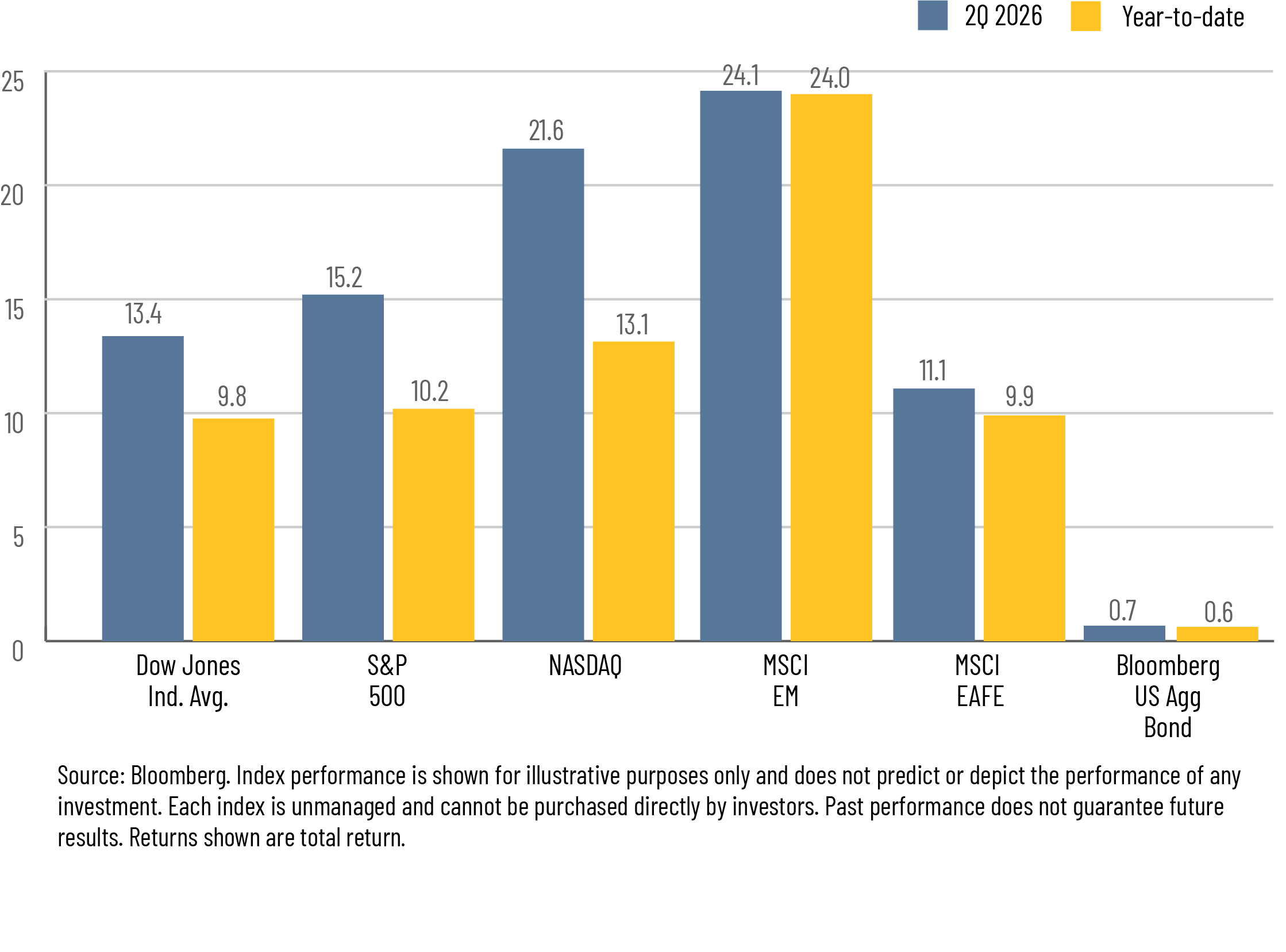
U.S. equities continued benefiting from healthy corporate fundamentals and ongoing investment in AI as it becomes adopted more broadly beyond the largest technology companies. The Dow Jones Industrial Average (DJIA) had Year-to-Date (YTD) gains of 9.76%, the S&P 500 was up 10.19%, and the Nasdaq Composite advanced 13.14%. Small Cap Value was the top performing equity style in the U.S. with returns of 23.15%, while Large Cap Growth was the bottom performer at 5.33%. The best performing sectors by mid-year in the U.S. were Industrials at 20.15%, Information Technology at 19.76%, and Energy at 19.66%. The bottom performing sectors were Financials at -1.31%, Consumer Discretionary at -0.77%, and Communication Services 0.80%. Emerging market stocks (MSCI EM) outperformed U.S. stocks by mid-year, returning 24.00%, while developed international stocks (MSCI EAFE) posted a solid gain of 9.90%.
Fixed Income
Higher interest rates continued providing attractive income opportunities across fixed income markets. With the Federal Reserve remaining patient and inflation gradually steadying, high-quality bonds once again demonstrated their value as both a source of income and portfolio diversification. By mid-year, the 6-month Treasury yield was 3.97%, the 2-year Treasury yield was 4.17%, and the 10-year Treasury was 4.47%. The 30-year Treasury yield was at 4.91%. The Bloomberg US Aggregate Bond Index returned 0.62%.
Index Return
Looking Ahead
The themes that defined the first half of 2026 are likely to remain important in the months ahead. Geopolitical unrest, trade policy and Federal Reserve decisions will continue to influence markets, but healthy consumers, resilient corporate earnings, and continued business investment provide a constructive foundation for the economy. While short-term uncertainty is inevitable, we continue to emphasize maintaining a diversified, long-term investment approach.Questions?
Please feel free to contact us at 989-779-6207 with any questions you might have. Our team is committed to helping you achieve your financial goals.
Wealth services are offered through Isabella Bank. Most wealth products are not insured by FDIC, are not a deposit or other obligation of, or guaranteed by, the depository institution, and are subject to investment risk including possible loss of the principal amount invested. Isabella Bank and its representative do not offer legal or tax advice. Please consult an independent tax advisor or attorney for more information.